These records are found in the online catalog of The Mariners’ Museum and Park in Newport News, Virginia. Uncurated search results are presented to give researchers and interested readers an idea of whether the museum’s archives contain information about this vessel and whether it may be worthwhile to visit the museum’s catalog search page for further investigation. Uncurated results may be inaccurate or incomplete.
Mariners Museum online catalog search, July 12, 2026. Search phrase: "Ernie". Catalog returned 21 records; this selection table includes 21 records fetched through catalog result pages.
Use these buttons to send uncurated search results to your own app or text document for further research. First, check the box for any row, or click "Select All" then uncheck any rows. Then click "Show Selections". You can then copy your selections from the text box and past them into your app.
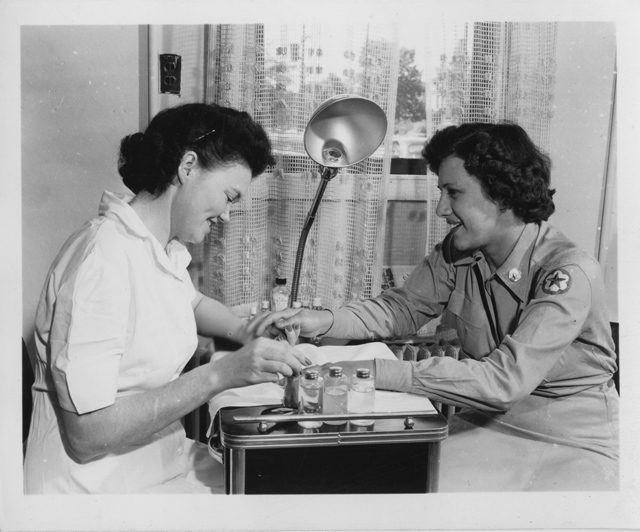
E3296 - Pfc. Ernie Babin, right, is seen having manicure in the WAAC beauty shop. At her left is beautician Isabel Forbus of the WAACs. 7-19-43 Official photograph U.S.Army Signal Corps, HRPE, Newport News, Va.
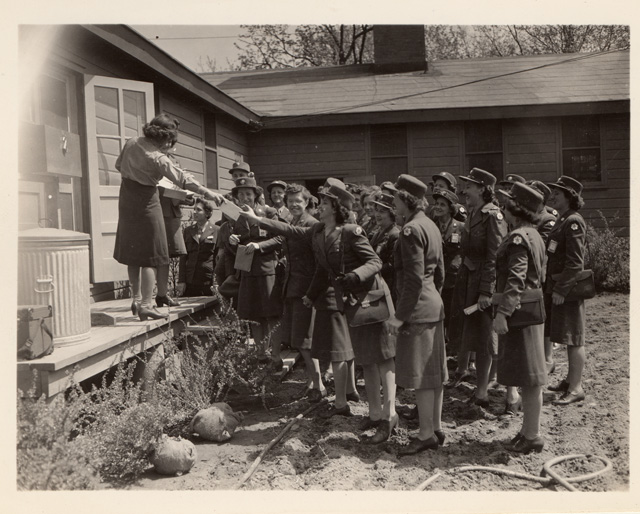
A group of some of the contingent of WAACs stationed at Port Hdq., HRPE, Newport News, Va., gathered around Auxiliary E. Babin, mail clerk, during mail call. 4-23-43 Official photograph U.S.Army Signal Corps, HRPE, Newport News, Virginia
A group of WAACs gathered around Private Ernie A. Babin. Private Eliza Allen is reaching out to take a letter.
J-9615 - "Back to school" costume dance at Service Club, finds Cpl. Ernie Babin of Baton Rouge, La., and T/5 Germaine La Voie of Portland, Oregon, enjoying the party in the role of juvenile twins. 9-2-44 Official Photograph, U. S. Army Signal Corps, HRPE, Newport News, Va. "RESTRICTED" stamped in red ink front and back.
Two WACs in matching dresses (white short sleeved blouse, embroidered and rick-rack trimmed short jumpers) and hairbows, one holding a stuffed Scotty dog, stand with a sailor and two soldiers.
Marine turbines–Design and construction.; Marine engineering–Germany.
Berechnung und Konstruktion der Schiffsmaschinen und -Kessel : - ein Handbuch zum Gebrauch für Konstructeure, Seemaschinisten und Studierende : Ergänzungsband, Schiffsturbinen - von G. Bauer and O. Lasche ; unter Mitwirkung von E. Ludwig
Members of the First WAC Company Basketball team taken at the Port Gym, HRPE, Newport News, Va. Photo taken for company files.
Basketball players–Virginia–Newport News.
Group portrait of WAC basketball team, showing ten women athletes with their coach and commanding officer. They are shown sitting on bleachers in a gym.
K6895 - 1st WAC Company Champion basketball team photographed in the HRPE gym. 3-15-44 Official Photograph, U. S. Army Signal Corps, HRPE, Newport News, Va.
E-9658 - HRPE WAC softball team. Photo was taken at the 85th C.A. grounds. 9-6-44 Official Photograph, U. S. Army Signal Corps, HRPE, Newport News, Va.
Shows WACs posing in two rows, the rear standing and the front kneeling. They all wear softball uniforms with the Transportation Corps logo on the left breast and athletic shoes. In front of them are three bats and a softball, behind them is the backstop and several buildings that resemble Camp Hill.
NEW YORK - NEW YORK - UNITED STATES - Maker; BERLIN - MARYLAND - UNITED STATES - Maker
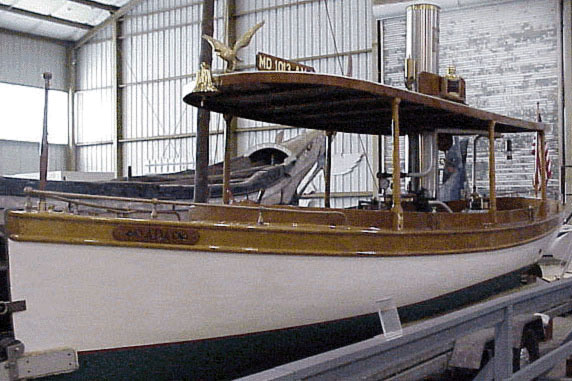
SHORT DESCRIPTION: Fantail launch called ADA. The launch was originally built by Charles Seabury and Company sometime in the late 19th century or early 20th century, possibly called Mosnee or Mosinee. The steam engine and boiler were built by Frank Fuegeman between the 1960s and 1986. The launch is 25 feet long and has a 6 foot beam. It has a full straight keel with round bilges and a rounded transom. The hull is made of white oak and white cedar. The hull is varnished on the interior with gloss white enamel on the exterior. The deck is varnished white oak, with white inlayed seams. The cockpit is surrounded by varnished oak coaming, steam bent into a round shape forward and aft. A full length hard canopy is over the cockpit. It is supported by turned oak varnished balustrades, six in all, bolted to the oak coaming. The canopy mirrors the round ends of the cockpit coaming using laminated varnished mahogany to make the shape. The canopy top is of thin aluminum, painted on top, and a bare milled finish on the underside. The entire center cockpit is consumbed by the firebox/boiler and steam engine. There are two general storage lockers forward, and two copper lined bins aft for fuel stowage of wood or coal. All four hatches are varnished, piano hinged. The cockpit sole is polished aluminum diamond pattern metal, with some liftouts, and some pieces fastened down. All of the hardware appears to be cast or machined bronze or brass. The engine is a 10hp single cylinder engine with matching steam boiler (scotch marine fire tube boiler). The engine is powered by either wood or coal. The boiler and heat exchanger are both partially sheathed in wood stripes, with strapping to hold the wood in place. The firebox is painted black. The stack is stainless steel and protrudes up through the canopy top. There is a water tank is forward and another off to port. Sheave and cable type steering. There are two wheels, one forward with mahogany with white inlay, and one on the starboard side aft that is brass with wood spokes. The boat is fitted with a three-bladed bronze propeller, which is supposedly original. There is metal rudder, the lower end of which resides in a bronze skeg that feeds off the wood keel. The boat has a triple note whistle. There is one small hanging liquid fuel lamp hanging from the canopy at the stern. There is a brass bell forward and a clanger type bell is aft, spring loaded and mounted on the underside of the canopy. There is a brass eagle decorating the forward end of the canopy. There are red and green fresnel running lights to either side of the stack on the top of the canopy. NOTES: Frank Fuegeman, a master machinist, purchased the launch in the 1960s from Vera and Ernie Blaser. They had purchased the launch in Maine "sometime before selling it to Frank." Fuegeman determined to build his own steam power plant. Over forty years he collected what he could and made by hand what he could not find. Ada was finally launched on September 1, 1986. The donor, H. W. Anderson, acquired the launch from Fuegeman in 1990. A sister ship to Ada is in the collection of the Independence Seaport Museum. NOTES: The bronze plate near the stern provides information for the manufacture of the original naphtha engine, which was removed from the boat in World War II, by the Gas Engine & Power Company. The hull was built by Charles Seabury and Company. It is unclear how the boat has been attributed to the launch called "Mosnee" (could it be "Mosinee"?). It is also unclear how the date of ca 1885 -1889 was attributed. The date circa 1896 was applied as that is when the Gas Engine & Power Co. and Charles L. Seabury & Co. formed a partnership in New York. The name of the company was not changed to Consolidated Shipbuilding until 1920. Approximately 3,000 to 5,000 naphtha launches were built between 1895 and 1905.
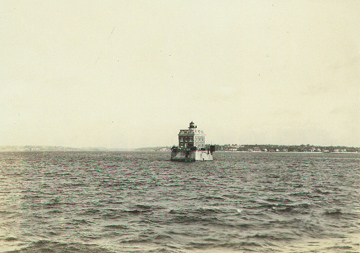
WRITTEN ON VERSO: NEW LONDON HARBOR LIGHTHOUSE, CONN., BUILT 1908, REBUILT 1909, 58 FT. HIGH
CURATOR NOTES: Distant view of lighthouse in harbor. This one-of-a-kind building was one of the last lighthouses built in New England, and it represents a rare case of an early 20th century offshore lighthouse that is not of cast-iron construction. The stately red brick building with its mansard roof and granite detailing makes a striking picture standing off by itself near the entrance to Connecticut's New London Harbor, at the extreme eastern end of Long Island Sound. The lighthouse reportedly owes its distinctive French Second Empire style to the influence of the wealthy home owners on the local coast, who wanted a structure in keeping with the elegance of their own homes. Many of the large homes near the shore in the area were destroyed in the great hurricane of September 21, 1938. By the early 1900s, New London, with its protected harbor at the mouth of the Thames River, had made the transition from whaling center to industrial city. New London Ledge Light was built because New London Harbor Light wasn't sufficient to direct vessels around the dangerous ledges at the entrance to the harbor. Lobbying for the lighthouse began in 1890. In 1903 the Lighthouse Board made this recommendation: The necessity for establishing a light and an efficient fog signal in such a position as to enable vessels to enter and leave the harbor of New London, Conn., has become evident, and especially so for the aid of those approaching from seaward. The numerous outlying shoals and ledges surrounding the entrance to this harbor make the approach to it dangerous in thick weather. ... In view of these facts... it is suggested that a light and fog signal station be established... The lighthouse was built by the Hamilton R. Douglas Company of New London. This company also built Groton Town Hall. The crib it stands on was constructed by the T.A. Scott Company in Groton and was towed to the site, where it was filled with concrete and rip-rap and sunk in 28 feet of water. A deposit, 82 feet square and 10 feet deep, surrounds and protects the foundation. A concrete pier, 50 feet square and rising 18 feet above low water, was constructed on top of the foundation. The pier contains cellar space and two water cisterns. The lighthouse was at first called Southwest Ledge Light, but the name was changed to avoid confusion with the lighthouse of the same name in New Haven Harbor. The cast-iron lantern rises from the center of the building's mansard roof. The lantern originally held a fourth-order Fresnel lens (now at the Custom House in New London) from the Henry- Company of Paris, with an incandescent oil vapor lamp. A clockwork mechanism had to be wound every four hours to keep the lens revolving. When it was first lighted, the New London Day reported that the light could be seen up to 18 miles away. The characteristic was three white flashes followed by a red flash every 30 seconds. A fog signal was added in 1911, replacing the one at New London Harbor Light. Howard B. Beebe was keeper during the hurricane of September 21,1938. He was in the lighthouse with a second assistant keeper and a tinsmith. Beebe's family was on shore at the time the gale struck. "It washed out everything," Keeper Beebe later told the Providence Journal: About 3:15, the engines conked out, but the light was going. We moved to the lantern. It was a three-story building. Waves were coming through the second floor. I've seen waves before, in the Bay of Fundy, but I never saw them like that. There was 11 tons of coal in the cellar, and it boiled it all out. Coast Guard crews lived at the lighthouse from 1939 until its automation in 1987. The crew worked in three man shifts, spending up to three weeks at the lighthouse followed by six days on shore. Somebody once explained why there were three men at the lighthouse at one time if two men had a fight, there would be a third to break it up. The Coast Guardsmen spent much of their time fishing and working out in the small gym in the lighthouse. According to Elinor De Wire, author of the book Guardians of the Lights, they were occasionally driven to distraction by the smells wafting from the mainland freshly mown lawns and barbecues as well as by the sight, viewable by binoculars, of young women on a nearby beach. New London Ledge Light was generally considered undesirable duty, but some enjoyed the solitude and beauty of the place. Petty Officer 1st Class Timothy Grant, a Maine native, told the New York Times in 1984, "After a week ashore, I can't wait to get back here." He knew it wasn't for everybody, adding, "This might be an ideal place for a loner, but it would drive whoever lives with him up a wall." Seaman Don Place put it simply, "You get a lot of time to think." Probably the best-known part of this station's history and lore is the lighthouse's infamous ghost, "Ernie." It's been claimed that in the 1920s or '30s, a keeper learned that his wife had run off with the captain of the Block Island ferry. Distraught, the keeper jumped or fell from the roof of the lighthouse to his death, the story goes. Some versions of this story say that Ernie's real name may have been John Randolf or Randolph. If there's any truth behind the legend, it's elusive. But there does seem to be unexplainable activity at the lighthouse. Doors have been known to open and close mysteriously, decks have swabbed themselves, televisions have turned themselves off, and the fog horn seems to turn on and off for no reason. Securely tied boats have mysteriously been set adrift. In 1987, New London Ledge Light became the last lighthouse on Long Island Sound to be automated. On the last day before automation, a Coast Guardsman entered in the log: Rock of slow torture. Ernie's domain. Hell on earth may New London Ledge's light shine on forever because I'm through. I will watch it from afar while drinking a brew. Today the lighthouse is leased to the New London Ledge Lighthouse Foundation. This group, with the help of grants and private contributions, has done some restoration of the building's interior. The plan is to eventually turn the building into a combination museum and bed and breakfast.
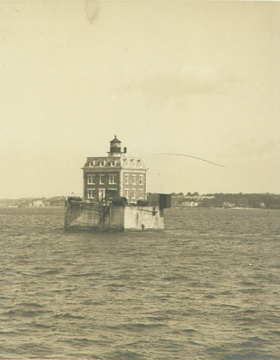
WRITTEN ON VERSO: NEW LONDON HARBOR LIGHTHOUSE, CONN., BUILT 1908, REBUILT 1909, 58 FT. HIGH
CURATOR NOTES: View of lighthouse in the harbor. History This one-of-a-kind building was one of the last lighthouses built in New England, and it represents a rare case of an early 20th century offshore lighthouse that is not of cast-iron construction. The stately red brick building with its mansard roof and granite detailing makes a striking picture standing off by itself near the entrance to Connecticut's New London Harbor, at the extreme eastern end of Long Island Sound. The lighthouse reportedly owes its distinctive French Second Empire style to the influence of the wealthy home owners on the local coast, who wanted a structure in keeping with the elegance of their own homes. Many of the large homes near the shore in the area were destroyed in the great hurricane of September 21, 1938. By the early 1900s, New London, with its protected harbor at the mouth of the Thames River, had made the transition from whaling center to industrial city. New London Ledge Light was built because New London Harbor Light wasn't sufficient to direct vessels around the dangerous ledges at the entrance to the harbor. Lobbying for the lighthouse began in 1890. In 1903 the Lighthouse Board made this recommendation: The necessity for establishing a light and an efficient fog signal in such a position as to enable vessels to enter and leave the harbor of New London, Conn., has become evident, and especially so for the aid of those approaching from seaward. The numerous outlying shoals and ledges surrounding the entrance to this harbor make the approach to it dangerous in thick weather. ... In view of these facts... it is suggested that a light and fog signal station be established... The lighthouse was built by the Hamilton R. Douglas Company of New London. This company also built Groton Town Hall. The crib it stands on was constructed by the T.A. Scott Company in Groton and was towed to the site, where it was filled with concrete and rip-rap and sunk in 28 feet of water. A rip-rap deposit, 82 feet square and 10 feet deep, surrounds and protects the foundation. A concrete pier, 50 feet square and rising 18 feet above low water, was constructed on top of the foundation. The pier contains cellar space and two water cisterns. The lighthouse was at first called Southwest Ledge Light, but the name was changed to avoid confusion with the lighthouse of the same name in New Haven Harbor. The cast-iron lantern rises from the center of the building's mansard roof. The lantern originally held a fourth-order Fresnel lens (now at the Custom House in New London) from the Henry-Lepaute Company of Paris, with an incandescent oil vapor lamp. A clockwork mechanism had to be wound every four hours to keep the lens revolving. When it was first lighted, the New London Day reported that the light could be seen up to 18 miles away. The characteristic was three white flashes followed by a red flash every 30 seconds. A fog signal was added in 1911, replacing the one at New London Harbor Light. Howard B. Beebe was keeper during the hurricane of September 21,1938. He was in the lighthouse with a second assistant keeper and a tinsmith. Beebe's family was on shore at the time the gale struck. "It washed out everything," Keeper Beebe later told the Providence Journal: About 3:15, the engines conked out, but the light was going. We moved to the lantern. It was a three-story building. Waves were coming through the second floor. I've seen waves before, in the Bay of Fundy, but I never saw them like that. There was 11 tons of coal in the cellar, and it boiled it all out. Coast Guard crews lived at the lighthouse from 1939 until its automation in 1987. The crew worked in three man shifts, spending up to three weeks at the lighthouse followed by six days on shore. Somebody once explained why there were three men at the lighthouse at one time if two men had a fight, there would be a third to break it up. The Coast Guardsmen spent much of their time fishing and working out in the small gym in the lighthouse. According to Elinor De Wire, author of the book Guardians of the Lights, they were occasionally driven to distraction by the smells wafting from the mainland freshly mown lawns and barbecues as well as by the sight, viewable by binoculars, of young women on a nearby beach. New London Ledge Light was generally considered undesirable duty, but some enjoyed the solitude and beauty of the place. Petty Officer 1st Class Timothy Grant, a Maine native, told the New York Times in 1984, "After a week ashore, I can't wait to get back here." He knew it wasn't for everybody, adding, "This might be an ideal place for a loner, but it would drive whoever lives with him up a wall." Seaman Don Place put it simply, "You get a lot of time to think." Probably the best-known part of this station's history and lore is the lighthouse's infamous ghost, "Ernie." It's been claimed that in the 1920s or '30s, a keeper learned that his wife had run off with the captain of the Block Island ferry. Distraught, the keeper jumped or fell from the roof of the lighthouse to his death, the story goes. Some versions of this story say that Ernie's real name may have been John Randolf or Randolph. If there's any truth behind the legend, it's elusive. But there does seem to be unexplainable activity at the lighthouse. Doors have been known to open and close mysteriously, decks have swabbed themselves, televisions have turned themselves off, and the fog horn seems to turn on and off for no reason. Securely tied boats have mysteriously been set adrift. In 1987, New London Ledge Light became the last lighthouse on Long Island Sound to be automated. On the last day before automation, a Coast Guardsman entered in the log: Rock of slow torture. Ernie's domain. Hell on earth may New London Ledge's light shine on forever because I'm through. I will watch it from afar while drinking a brew. Today the lighthouse is leased to the New London Ledge Lighthouse Foundation. This group, with the help of grants and private contributions, has done some restoration of the building's interior. The plan is to eventually turn the building into a combination museum and bed and breakfast.
 E3296
 E1729MAILCALL
 P0003-01 - J-9615
 P0003-01 - E-9661
 P0003-01 - E-13024
 P0003-01 - K-6895
 P0003-01 - E-9658
 2000.53.01
 Full-size image
 Full-size image